SEO is a long-term strategy, and results don’t usually happen overnight. Most businesses can expect to see noticeable progress within 3–6 months. However, the timeframe can vary depending on factors such as website age, keyword competition, technical health, content quality, website authority, and the strategy being implemented.
How Long Does SEO Take to Work?
For many businesses, meaningful progress can take 3–6 months. Some websites may see improvements sooner, particularly after resolving technical problems, optimizing existing pages, or targeting less competitive search terms.
SEO requires consistent work rather than a one-time change. Technical improvements, useful content, optimization, and regular monitoring all contribute to long-term organic growth.
What Is the Typical SEO Results Timeline?
A typical campaign may progress through several stages:
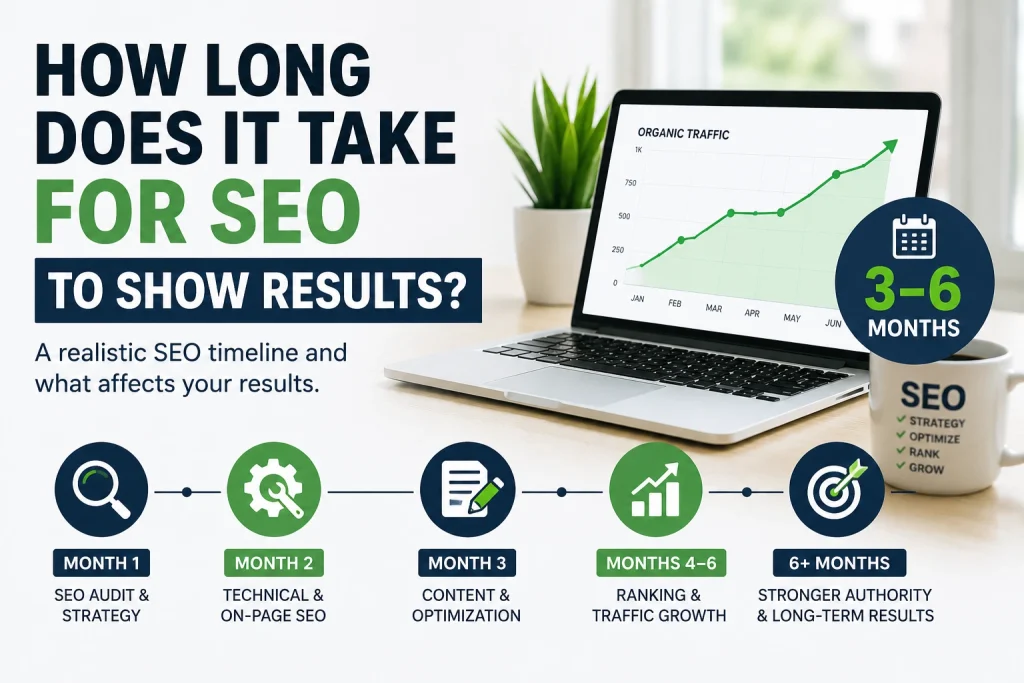
- Month 1: Website audit, keyword research, and strategy development
- Month 2: Technical and on-page optimization
- Month 3: Content improvements and increased search visibility
- Months 4–6: Ranking, organic traffic, and lead growth
- 6+ months: Continued optimization and stronger organic visibility
These timeframes are general estimates rather than guarantees. Every website, industry, and market has different levels of competition.
How Long Does Local SEO Take?
Local SEO can sometimes produce early improvements within 1–3 months, especially when a business has an established Google Business Profile and clear opportunities for optimization.
Within 3–6 months, a business may experience improvements in:
- Local keyword rankings
- Google Maps visibility
- Website visits
- Phone calls
- Direction requests
- Customer enquiries
Businesses operating in highly competitive locations may require additional time to build stronger local visibility.
What Factors Affect SEO Results?
Several factors can influence how quickly a website improves in search:
- Website age – Newer websites may need more time to establish authority.
- Keyword competition – Competitive search terms generally require more effort and resources.
- Technical health – Crawling, indexing, website speed, mobile usability, and site structure can affect performance.
- Content quality – Helpful content that satisfies search intent creates stronger opportunities to rank.
- Website authority – Established websites may have an advantage over newer domains.
- Local competition – The number and strength of nearby competitors can affect visibility.
- Consistency – Regular optimization and content improvements support sustainable growth.
How Can You Measure SEO Performance?
Rankings are only one part of the picture. To understand whether your strategy is working, monitor:
- Organic rankings
- Organic traffic
- Search impressions
- Organic clicks
- Leads and enquiries
- Google Business Profile interactions
- Phone calls
- Website conversions
Google Search Console and Google Analytics can help you track these metrics and identify opportunities for improvement.
When Can You Expect Early Improvements?
Some websites can experience positive changes within weeks or a few months. This may happen after fixing significant technical issues, properly indexing important pages, or improving content that already has ranking potential.
However, early gains do not necessarily mean sustainable growth. Maintaining strong performance requires ongoing optimization, quality content, authority building, and regular analysis.
Building Long-Term Organic Growth
Search optimization should be viewed as an ongoing investment rather than a quick fix. Improving your website, creating useful content, resolving technical issues, and monitoring performance can gradually strengthen your online visibility.
The goal isn’t simply to achieve higher rankings. A successful strategy should attract relevant visitors and turn that traffic into enquiries, leads, and customers.
Conclusion
So, how long does it take for SEO to show results? For many businesses, a realistic expectation is 3–6 months for meaningful progress, although technical improvements and Local SEO changes may appear sooner.
The exact timeframe depends on your website, industry, competition, content, and current online presence. A consistent strategy combined with regular monitoring and optimization can help build sustainable organic growth over time.

Kenneth Relox is an Expert Freelance SEO Specialist in the Philippines specializing in Technical SEO, WordPress SEO, Local SEO, Content SEO, and Generative Engine Optimization (GEO). With over a decade of professional experience in Search Engine Optimization, Global E-Commerce Quality Analysis, and Content Moderation Quality Assurance, he combines technical expertise with data-driven strategies to help businesses achieve sustainable online growth.
In 2026, Kenneth enhanced his SEO expertise by completing the PinoySEO Training and Internship Program, where he gained advanced knowledge in WordPress SEO, technical website optimization, AI-powered search optimization, and GEO (Generative Engine Optimization). This experience strengthened his ability to help businesses adapt to the evolving landscape of search engines and AI-driven search experiences.
As the founder of Kenneth Relox – SEO & GEO Services, Kenneth is committed to helping businesses improve their online visibility, increase organic traffic, generate qualified leads, and achieve long-term success through ethical and results-focused SEO strategies.
When he’s not optimizing websites, Kenneth enjoys playing basketball, working out, discovering local travel destinations in the Philippines, and staying up to date with the latest trends in SEO, AI, and digital marketing.